

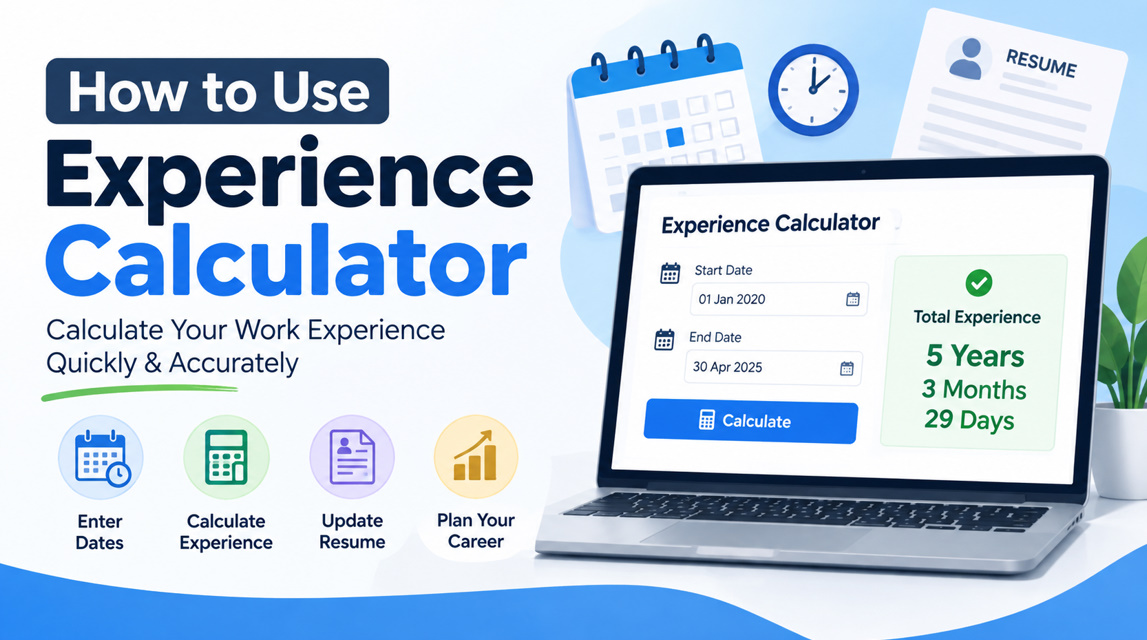
An Experience Calculator is a useful online tool for calculating the total length of employment, professional experience, or service between two or more dates. Instead of manually counting years, months, and days, users can enter relevant dates and receive a quick result.
Whether you are a student, job seeker, employee, recruiter, or professional preparing a CV, an experience calculator can simplify date calculations. Understanding how the tool works also helps you verify employment history and present your career experience accurately.
What Is an Experience Calculator?
An Experience Calculator is a date-based online calculator designed to determine how much time has passed between two dates. Depending on the tool, it may calculate experience in years, months, and days or provide a total duration in months or days. This makes complex date calculations easier.
The calculator is particularly helpful when you have worked for several companies or held multiple positions. By entering each employment period separately, you can estimate your overall professional experience. It reduces manual calculations and helps prevent common mistakes involving different month lengths, leap years, and date boundaries.
- Calculates employment duration
- Measures professional experience
- Uses start and end dates
- Shows years and months
- Handles date differences
- Simplifies manual calculations
- Supports career planning
- Helps verify work history
Why Use an Experience Calculator?
Using an Experience certificate Calculator saves time when you need to determine the exact duration of employment or another period of experience. Manually calculating dates can become confusing, especially when several jobs overlap or employment periods contain different numbers of days. A calculator provides a convenient starting point for accurate results.
The tool can also help when preparing resumes, job applications, professional profiles, and employment records. Recruiters and applicants can use calculated experience periods to understand career timelines more clearly. For people asking, “How many years of experience do I have?”, this type of calculator offers a simple answer.
- Saves valuable time
- Reduces calculation effort
- Checks career duration
- Supports resume preparation
- Helps job applications
- Simplifies employment records
- Clarifies career timelines
- Improves date accuracy
How to Enter Dates in an Experience Calculator
To use an Experience Calculator, first identify the beginning and ending dates of the experience period. Enter the starting date in the appropriate field, followed by the ending date. Some calculators may ask for the day, month, and year separately, while others provide a calendar interface.
Always check the dates before calculating the result. A small mistake in the joining date or leaving date can change the total experience. If you are calculating current employment, some tools allow you to use the present date as the end date instead of entering a fixed date.
- Find the joining date
- Find the ending date
- Select the correct day
- Choose the month
- Enter the year
- Check date format
- Review entered information
- Click the calculate button
How to Calculate Work Experience Step by Step
The basic process is straightforward. Enter the date when your employment started and the date when it ended, then select the calculation option. The tool compares both dates and determines the elapsed period. Depending on its features, the result may appear as years, months, days, or another unit to get experience letter
For multiple jobs, calculate each employment period individually when the calculator does not automatically combine dates. Record each result and then combine the durations carefully. Avoid counting the same period twice, particularly when employment dates overlap. This produces a more reliable total work experience calculation.
- Enter the first start date
- Enter the first end date
- Calculate the duration
- Record the result
- Add another employment period
- Check for overlapping dates
- Combine valid periods
- Review the final total
How to Calculate Experience for Multiple Jobs
Many professionals have experience with several employers, internships, freelance projects, or contract positions. In these situations, an Experience Calculator can help calculate each period separately. For example, you can calculate the duration of your first job, then repeat the process for your second and third positions.
When adding multiple periods, pay close attention to overlapping employment dates. If two jobs occurred simultaneously, simply adding both durations may overstate your total chronological experience. However, overlapping roles can still represent valuable professional experience. The correct approach depends on whether you need elapsed time or combined career experience.
- List every employer
- Record each start date
- Record each end date
- Calculate each period
- Identify overlapping jobs
- Avoid duplicate periods
- Add separate durations carefully
- Verify the final result
How to Check Your Experience Calculator Result
After receiving your result, review it against your original employment records. Compare the calculated years, months, and days with joining letters, relieving documents, contracts, pay slips, or other records where appropriate. This additional check is useful when the result will be used for an important application.
Remember that different calculators may display durations differently. One tool might report a period as years and months, while another may convert the same duration into total months or days. Therefore, understand the calculator’s counting method before using the result for official documentation.
- Review the start date
- Review the end date
- Check calculated years
- Check calculated months
- Check calculated days
- Compare employment records
- Understand calculation rules
- Confirm the final result
Benefits of Experience Calculator
One of the biggest Benefits of Experience Calculator tools is convenience. Instead of manually counting calendar periods, users can obtain a result quickly. This is particularly useful for people with long employment histories, multiple positions, internships, temporary contracts, or career gaps that make manual calculations more complicated.
An experience calculator can also improve confidence when preparing professional documents. Knowing your approximate or calculated work experience can help you complete application forms, update a CV, prepare for interviews, and organize your career timeline. It is a practical tool for students, employees, freelancers, recruiters, and job seekers.
- Provides quick calculations
- Reduces manual work
- Helps organize career history
- Supports CV preparation
- Simplifies job applications
- Helps identify experience gaps
- Improves calculation consistency
- Makes date comparison easier
Common Mistakes When Using an Experience Calculator
Incorrect dates are one of the most common reasons for inaccurate experience calculations. Users may accidentally reverse the start and end dates, select the wrong year, or enter an incorrect joining date. Always double-check the information before pressing the calculation button to avoid an incorrect work experience total.
Another common mistake is adding overlapping employment periods without considering duplicated time. It is also important to distinguish between chronological employment duration and total professional experience. If an employer or application provides specific rules for counting experience, follow those rules rather than relying solely on a calculator.
- Entering the wrong year
- Reversing dates
- Selecting the wrong month
- Forgetting an employment period
- Counting overlap twice
- Ignoring career breaks
- Misreading the result
- Failing to verify records